Chart-Plotly
view release on metacpan or search on metacpan
lib/Chart/Plotly/Trace/Scattergeo.pm view on Meta::CPAN
            my $type  = $attr->type_constraint;
            if ( $type && $type->equals('Bool') ) {
                $hash{$name} = $value ? \1 : \0;
            }
        }
    }
    my $plotly_meta = delete $hash{'pmeta'};
    if ( defined $plotly_meta ) {
        $hash{'meta'} = $plotly_meta;
    }
    %hash = ( %hash, %$extra_args );
    delete $hash{'extra_args'};
    if ( $self->can('type') && ( !defined $hash{'type'} ) ) {
        $hash{type} = $self->type();
    }
    return \%hash;
}

sub type {
    my @components = split( /::/, __PACKAGE__ );
    return lc( $components[-1] );
}

has connectgaps => (
           is            => "rw",
           isa           => "Bool",
           documentation =>
             "Determines whether or not gaps (i.e. {nan} or missing values) in the provided data arrays are connected.",
);

has customdata => (
    is            => "rw",
    isa           => "ArrayRef|PDL",
    documentation =>
      "Assigns extra data each datum. This may be useful when listening to hover, click and selection events. Note that, *scatter* traces also appends customdata items in the markers DOM elements",
);

has customdatasrc => ( is            => "rw",
                       isa           => "Str",
                       documentation => "Sets the source reference on Chart Studio Cloud for `customdata`.",
);

has featureidkey => (
    is            => "rw",
    isa           => "Str",
    documentation =>
      "Sets the key in GeoJSON features which is used as id to match the items included in the `locations` array. Only has an effect when `geojson` is set. Support nested property, for example *properties.name*.",
);

has fill => (
    is            => "rw",
    isa           => enum( [ "none", "toself" ] ),
    documentation =>
      "Sets the area to fill with a solid color. Use with `fillcolor` if not *none*. *toself* connects the endpoints of the trace (or each segment of the trace if it has gaps) into a closed shape.",
);

has fillcolor => (
    is            => "rw",
    isa           => "Str",
    documentation =>
      "Sets the fill color. Defaults to a half-transparent variant of the line color, marker color, or marker line color, whichever is available.",
);

has geo => (
    is            => "rw",
    documentation =>
      "Sets a reference between this trace's geospatial coordinates and a geographic map. If *geo* (the default value), the geospatial coordinates refer to `layout.geo`. If *geo2*, the geospatial coordinates refer to `layout.geo2`, and so on.",
);

has geojson => (
    is            => "rw",
    isa           => "Any",
    documentation =>
      "Sets optional GeoJSON data associated with this trace. If not given, the features on the base map are used when `locations` is set. It can be set as a valid GeoJSON object or as a URL string. Note that we only accept GeoJSONs of type *FeatureC...
);

has hoverinfo => (
    is            => "rw",
    isa           => "Str|ArrayRef[Str]",
    documentation =>
      "Determines which trace information appear on hover. If `none` or `skip` are set, no information is displayed upon hovering. But, if `none` is set, click and hover events are still fired.",
);

has hoverinfosrc => ( is            => "rw",
                      isa           => "Str",
                      documentation => "Sets the source reference on Chart Studio Cloud for `hoverinfo`.",
);

has hoverlabel => ( is  => "rw",
                    isa => "Maybe[HashRef]|Chart::Plotly::Trace::Scattergeo::Hoverlabel", );

has hovertemplate => (
    is            => "rw",
    isa           => "Str|ArrayRef[Str]",
    documentation =>
      "Template string used for rendering the information that appear on hover box. Note that this will override `hoverinfo`. Variables are inserted using %{variable}, for example \"y: %{y}\" as well as %{xother}, {%_xother}, {%_xother_}, {%xother_}....
);

has hovertemplatesrc => ( is            => "rw",
                          isa           => "Str",
                          documentation => "Sets the source reference on Chart Studio Cloud for `hovertemplate`.",
);

has hovertext => (
    is            => "rw",
    isa           => "Str|ArrayRef[Str]",
    documentation =>
      "Sets hover text elements associated with each (lon,lat) pair or item in `locations`. If a single string, the same string appears over all the data points. If an array of string, the items are mapped in order to the this trace's (lon,lat) or `l...
);

has hovertextsrc => ( is            => "rw",
                      isa           => "Str",
                      documentation => "Sets the source reference on Chart Studio Cloud for `hovertext`.",
);

has ids => (
    is            => "rw",
    isa           => "ArrayRef|PDL",
    documentation =>
      "Assigns id labels to each datum. These ids for object constancy of data points during animation. Should be an array of strings, not numbers or any other type.",
);
lib/Chart/Plotly/Trace/Scattergeo.pm view on Meta::CPAN
Screenshot of the above example:
=for HTML <p>
<img src="https://raw.githubusercontent.com/pablrod/p5-Chart-Plotly/master/examples/traces/scattergeo.png" alt="Screenshot of the above example">
</p>
=for markdown 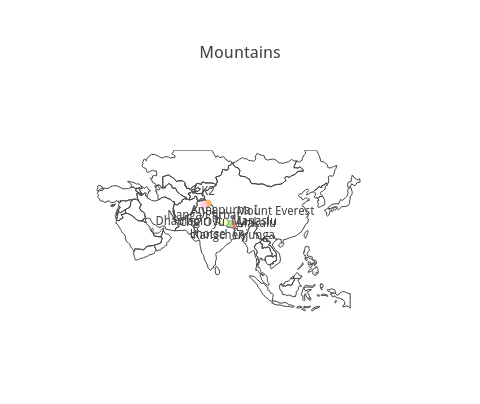
=for HTML <p>
<iframe src="https://raw.githubusercontent.com/pablrod/p5-Chart-Plotly/master/examples/traces/scattergeo.html" style="border:none;" width="80%" height="520"></iframe>
</p>
This file has been autogenerated from the official plotly.js source.
If you like Plotly, please support them: L<https://plot.ly/>
Open source announcement: L<https://plot.ly/javascript/open-source-announcement/>
Full reference: L<https://plot.ly/javascript/reference/#scattergeo>
=head1 DISCLAIMER
This is an unofficial Plotly Perl module. Currently I'm not affiliated in any way with Plotly.
But I think plotly.js is a great library and I want to use it with perl.
=head1 METHODS
=head2 TO_JSON
Serialize the trace to JSON. This method should be called only by L<JSON> serializer.
=head2 type
Trace type.
=head1 ATTRIBUTES
=over
=item * connectgaps
Determines whether or not gaps (i.e. {nan} or missing values) in the provided data arrays are connected.
=item * customdata
Assigns extra data each datum. This may be useful when listening to hover, click and selection events. Note that, *scatter* traces also appends customdata items in the markers DOM elements
=item * customdatasrc
Sets the source reference on Chart Studio Cloud for `customdata`.
=item * featureidkey
Sets the key in GeoJSON features which is used as id to match the items included in the `locations` array. Only has an effect when `geojson` is set. Support nested property, for example *properties.name*.
=item * fill
Sets the area to fill with a solid color. Use with `fillcolor` if not *none*. *toself* connects the endpoints of the trace (or each segment of the trace if it has gaps) into a closed shape.
=item * fillcolor
Sets the fill color. Defaults to a half-transparent variant of the line color, marker color, or marker line color, whichever is available.
=item * geo
Sets a reference between this trace's geospatial coordinates and a geographic map. If *geo* (the default value), the geospatial coordinates refer to `layout.geo`. If *geo2*, the geospatial coordinates refer to `layout.geo2`, and so on.
=item * geojson
Sets optional GeoJSON data associated with this trace. If not given, the features on the base map are used when `locations` is set. It can be set as a valid GeoJSON object or as a URL string. Note that we only accept GeoJSONs of type *FeatureCollecti...
=item * hoverinfo
Determines which trace information appear on hover. If `none` or `skip` are set, no information is displayed upon hovering. But, if `none` is set, click and hover events are still fired.
=item * hoverinfosrc
Sets the source reference on Chart Studio Cloud for `hoverinfo`.
=item * hoverlabel
=item * hovertemplate
Template string used for rendering the information that appear on hover box. Note that this will override `hoverinfo`. Variables are inserted using %{variable}, for example "y: %{y}" as well as %{xother}, {%_xother}, {%_xother_}, {%xother_}. When sho...
=item * hovertemplatesrc
Sets the source reference on Chart Studio Cloud for `hovertemplate`.
=item * hovertext
Sets hover text elements associated with each (lon,lat) pair or item in `locations`. If a single string, the same string appears over all the data points. If an array of string, the items are mapped in order to the this trace's (lon,lat) or `location...
=item * hovertextsrc
Sets the source reference on Chart Studio Cloud for `hovertext`.
=item * ids
Assigns id labels to each datum. These ids for object constancy of data points during animation. Should be an array of strings, not numbers or any other type.
=item * idssrc
Sets the source reference on Chart Studio Cloud for `ids`.
=item * lat
Sets the latitude coordinates (in degrees North).
=item * latsrc
Sets the source reference on Chart Studio Cloud for `lat`.
=item * legendgroup
Sets the legend group for this trace. Traces part of the same legend group hide/show at the same time when toggling legend items.
=item * legendgrouptitle
=item * legendrank
Sets the legend rank for this trace. Items and groups with smaller ranks are presented on top/left side while with `*reversed* `legend.traceorder` they are on bottom/right side. The default legendrank is 1000, so that you can use ranks less than 1000...
( run in 0.537 second using v1.01-cache-2.11-cpan-7fcb06a456a )